

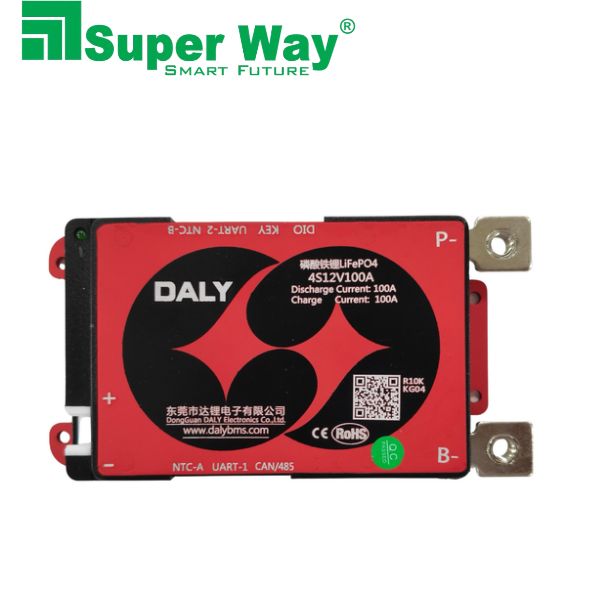
DALY Smart BMS 4S 100A for LFP Battery
Original price was: ₹4,600.00.₹1,700.00Current price is: ₹1,700.00.
WHOLESALE PRICE
- Designed for 4S LFP battery pack configurations.
- Supports a specified current rating of 100A.
- Intended for four series-connected battery cell groups.
- Suitable for compatible 12.8V nominal LFP battery packs.
- Smart BMS design for battery management applications.
- Requires correct wiring and configuration according to product specifications.
Did you like this product? Add to favorites now and follow the product.
Description
The DALY Smart BMS 4S 100A for LFP Battery is designed for lithium iron phosphate battery pack applications requiring a 4S configuration. It carries a specified current rating of 100A and is intended for battery packs containing four cell groups connected in series. Its smart BMS design makes it suitable for battery assembly projects where a dedicated 4S LFP management board is required.
A 4S LFP battery pack contains four cell groups connected in series. With a nominal voltage of approximately 3.2V per cell group, the pack has a nominal voltage of approximately 12.8V. The actual operating voltage and charging requirements depend on the battery cells and their manufacturer’s specifications. Always ensure that the selected BMS matches the battery chemistry and series configuration.
The specified 100A current rating is an important factor when selecting this product. The actual permitted operating current depends on the manufacturer’s specifications, circuit design, temperature, wiring, connectors, and installation conditions. Confirm the continuous and peak current limits before connecting a load or charger. The battery cells, cables, connectors, and other electrical components must also be suitable for the intended current requirements.
The smart BMS design is intended to support battery management functions according to the features available in the exact model version. Communication and monitoring options may differ between variants. Features such as Bluetooth, mobile application monitoring, UART, CAN, or RS485 should be confirmed from the product documentation before purchase. Do not assume that every version includes the same communication interfaces or accessories.
Protection functions can also vary depending on the circuit design and model version. Check the manufacturer’s documentation for details about overcharge protection, over-discharge protection, overcurrent protection, short-circuit protection, temperature monitoring, and balancing functionality. Protection thresholds and balancing specifications should be verified for the exact product.
Before installation, verify that the battery pack contains four series-connected LFP cell groups and that the BMS wiring arrangement matches the battery configuration. Check the terminal markings, polarity, connector pinout, and wiring diagram before making connections. The charging voltage and current must follow the battery cell manufacturer’s recommendations, and the charger must be suitable for a 4S LFP battery pack.
The DALY Smart BMS 4S 100A for LFP Battery may be considered for suitable 12.8V nominal battery pack applications where its current rating and available functions meet the requirements. Use appropriately rated wires and connectors, maintain proper insulation, and ensure secure electrical connections. Battery pack assembly and testing should be carried out by someone familiar with lithium battery systems.
This product is offered under the SUPERWAY brand through Superway. Before ordering, confirm the exact DALY model version, 100A current rating, smart monitoring features, communication options, connector arrangement, and technical specifications. Selecting a BMS that matches the battery chemistry, series configuration, and electrical requirements is important for an appropriate battery management arrangement.

DALY Smart BMS 4S 100A for LFP Battery
Original price was: ₹4,600.00.₹1,700.00Current price is: ₹1,700.00.
We are committed to quality, innovation, and powering your needs with trusted energy products.
Copyright 2026 © lithiumbatterys.com

Reviews
There are no reviews yet.