

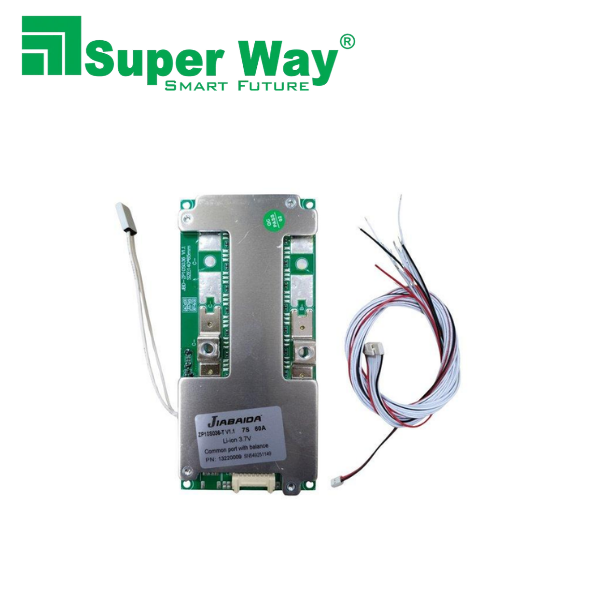
BMS NMC 7S 60A ZP10S036
Original price was: ₹2,000.00.₹750.00Current price is: ₹750.00.
WHOLESALE PRICE
- Product Type: Battery Management System (BMS)
- Battery Chemistry: NMC (Nickel Manganese Cobalt)
- Cell Configuration: 7S (7 cells connected in series)
- Current Rating: 60A, as indicated by the product specification
- Model Number: ZP10S036
- Application: Designed for compatible 7S NMC lithium battery pack configurations; verify electrical compatibility before installation.
Did you like this product? Add to favorites now and follow the product.
Description
The BMS NMC 7S 60A ZP10S036 is a Battery Management System intended for compatible seven-series-cell lithium-ion battery pack configurations using NMC battery chemistry. A Battery Management System plays an important role in monitoring and managing a rechargeable battery pack. It helps the battery pack operate within its specified electrical limits when the appropriate monitoring and protection functions are included in its design. This product is identified by its 7S configuration, 60A current rating, and ZP10S036 model number, making these details important when selecting a suitable BMS for a battery project. SUPERWAY presents this product for customers looking for battery management components for compatible lithium battery systems, electronic projects, and battery pack assembly requirements.
NMC stands for Nickel Manganese Cobalt, a lithium-ion battery chemistry used in various rechargeable battery applications. A seven-series configuration, commonly written as 7S, means that seven cell groups are connected in series. The series arrangement determines the battery pack’s nominal voltage and charging voltage according to the specifications of the cells being used. The exact voltage values depend on the particular NMC cells and their manufacturer-defined operating limits. For this reason, users should confirm the cell specifications and the required charging voltage before choosing a BMS. A BMS must be matched to the actual battery chemistry and series configuration rather than selected by the current rating alone.
The 60A designation is an important identification detail for this model. However, the practical current capability of a complete battery system depends on the BMS specifications, cooling conditions, wiring, connectors, battery cells, and the operating environment. Buyers should verify the manufacturer’s documentation to determine the continuous current rating, any permitted peak current, temperature limits, and other operating conditions. The number printed in a product name should not be treated as confirmation that the system can continuously deliver that current under every condition. The connected battery cells and all other components must also be rated appropriately for the intended load.
A Battery Management System can perform several functions depending on its circuit design. These may include monitoring cell-group voltages, controlling charging and discharging, and providing protection against conditions such as excessive current, overvoltage, undervoltage, or excessive temperature. Not every BMS includes every function, and the presence of a particular feature should be confirmed from the technical documentation for the exact model. Customers should therefore check the available protection functions and their operating thresholds before installing the ZP10S036 in a battery pack. This helps ensure that the selected component meets the electrical requirements of the intended application.
Cell balancing is another feature that may be available in some BMS designs. Balancing helps manage differences in voltage between cell groups during the battery’s operating cycle. Whether this model provides balancing, and whether that balancing is passive or active, should be verified before purchase. It is also important to confirm the supported balancing current and the conditions under which balancing operates. Do not assume that a BMS has a balancing function simply because it is intended for a multi-series battery pack. The correct technical information should come from the product specification or supplier documentation.
Compatibility is essential when integrating the BMS into a battery pack. Before purchasing, check that the pack uses NMC chemistry, has the required seven-series-cell configuration, and falls within the model’s specified voltage and current limits. Confirm the wiring arrangement, connector type, terminal layout, communication options if applicable, and any required temperature sensors. These details can vary between models, even when their series count and current rating appear similar. The ZP10S036 model identifier should be used when requesting the exact wiring diagram and technical specification from the supplier.
Correct installation is important for battery safety and reliable operation. Battery cells should be assembled using a suitable design, with appropriate insulation, conductors, connectors, and enclosure arrangements. Incorrect connections or an unsuitable wiring sequence may damage the BMS or battery pack. The connection order must follow the manufacturer’s instructions for the exact model. Before connecting a load or charger, verify the battery polarity, cell-group voltages, and all electrical connections using suitable test equipment and safe working procedures. Installation should be performed by a person with appropriate battery-system knowledge, particularly when working with high-current lithium battery packs.
The charger must also be compatible with the specific NMC battery pack. Its charging voltage and current should follow the battery-cell manufacturer’s requirements and the limits of the complete battery system. A suitable charger does not replace the need for a correctly selected BMS, and a BMS should not be used to compensate for incompatible cells, damaged wiring, or an incorrectly configured charger. Similarly, the load should remain within the documented limits of the cells, BMS, wiring, connectors, and other components. The complete assembly should be inspected before it is placed into service.
Potential applications for a 7S NMC BMS may include compatible rechargeable battery packs used in electronic equipment, portable power projects, and other battery-powered systems. Actual suitability depends on the system’s voltage requirements, operating current, physical dimensions, wiring arrangement, and required protection features. Buyers should assess these requirements before choosing this model for a new design or replacement project. If replacing an existing BMS, compare the original unit’s specifications and wiring diagram rather than relying only on the model’s appearance or current rating.
When selecting the BMS NMC 7S 60A ZP10S036, keep the key identification details together: NMC battery chemistry, seven-series configuration, stated 60A current rating, and ZP10S036 model number. Confirm all additional specifications with the supplier before installation, especially continuous and peak current limits, voltage thresholds, balancing support, temperature monitoring, connector arrangement, and protection features. This careful selection process helps reduce compatibility issues and supports safer integration into a suitable battery system.
The BMS NMC 7S 60A ZP10S036 is a component for users seeking a battery management solution for a compatible seven-series NMC lithium-ion battery pack. SUPERWAY provides this product listing to help buyers identify the required configuration and model when sourcing battery management components. Review the exact technical documentation and confirm compatibility with your battery cells, charger, load, and wiring before purchasing or installing the unit.
Recently Viewed Products
BMS NMC 13S 40A P13S40A1TNS
Original price was: ₹1,500.00.₹600.00Current price is: ₹600.00.
BMS NMC 7S 60A ZP10S036
Original price was: ₹2,000.00.₹750.00Current price is: ₹750.00.
We are committed to quality, innovation, and powering your needs with trusted energy products.
Copyright 2026 © lithiumbatterys.com

Reviews
There are no reviews yet.