

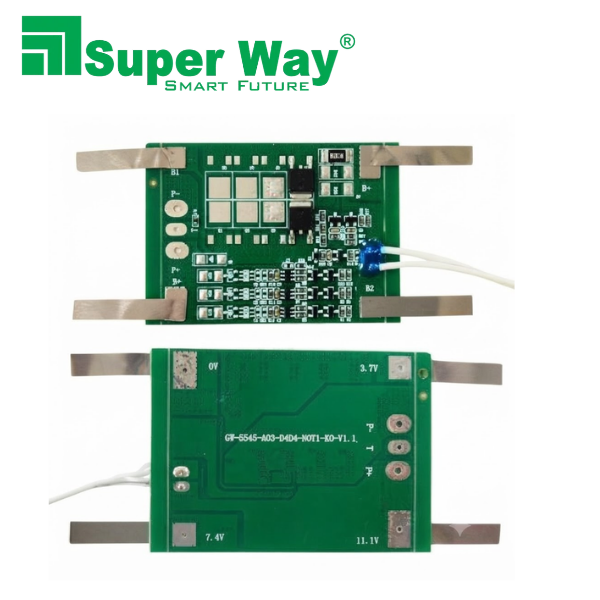
BMS NMC 3S 6A With Nickel Without Balancing
Original price was: ₹120.00.₹40.00Current price is: ₹40.00.
WHOLESALE PRICE
- Designed for compatible NMC lithium-ion battery packs.
- Supports a 3S configuration with three cell groups connected in series.
- Rated current: 6A, subject to the module’s specifications and operating conditions.
- Supplied with nickel strips, as indicated in the product name.
- Without balancing functionality, as indicated in the product name.
- Verify battery voltage, nickel strip dimensions, wiring connections, and protection specifications before installation.
Did you like this product? Add to favorites now and follow the product.
Description
The BMS NMC 3S 6A With Nickel Without Balancing is a battery management system intended for compatible lithium nickel manganese cobalt oxide (NMC) battery packs arranged in a three-series configuration. A Battery Management System, commonly known as a BMS, is an electronic circuit designed to help manage the operating conditions of a rechargeable battery pack. The 3S designation indicates three cell groups connected in series, while the 6A rating identifies the stated current rating of the module. The product name also indicates that nickel strips are included and that the board does not provide balancing functionality. Buyers should verify the complete specifications before selecting this module for a particular battery project.
NMC is a lithium-ion battery chemistry used in various rechargeable battery applications. Battery packs using this chemistry require compatible charging equipment and appropriate battery management components. A suitable BMS must match the battery chemistry, series configuration, current requirements, charging limits, and connection arrangement. Choosing a board based only on its current rating is not sufficient because different modules may have different electrical characteristics and protection functions. Confirm the product documentation and battery requirements before installation.
A 3S battery pack contains three cell groups connected in series. For conventional NMC lithium-ion cells, each group commonly has a nominal voltage of approximately 3.6V to 3.7V. This gives a typical nominal pack voltage of approximately 10.8V to 11.1V. If the cells have a maximum charging voltage of 4.2V per cell, the pack may reach 12.6V when fully charged. These figures are general reference values, not guaranteed specifications for every cell. The actual cell manufacturer’s documentation must determine the permitted voltage range and charging method.
The stated 6A current rating is an important factor when matching the module to the intended battery-powered equipment. The current drawn by the load must remain within the permitted limits of the BMS, battery cells, wiring, nickel strips, connectors, and other components. The 6A label should not automatically be interpreted as a guaranteed continuous current under all operating conditions. Actual current capability may depend on circuit design, temperature, heat dissipation, installation conditions, and operating duration. Check the technical documentation to establish whether the rating represents continuous current or another specified operating condition.
The included nickel strips can be useful when assembling compatible battery connections. However, their suitability depends on their dimensions, thickness, material, connection method, and current-carrying requirements. The product name does not specify the nickel strip dimensions or establish their exact electrical capacity. Verify these details before use. Battery assembly should use appropriate joining methods, insulation, and tools suitable for the selected cells. Incorrect connections or unsuitable conductive materials can create resistance, overheating, or short-circuit risks.
This model is described as being without balancing. In a series-connected battery pack, individual cell groups can gradually develop different voltage levels during charging and discharging. A balancing circuit is designed to help manage differences between cell groups, but this product name indicates that balancing functionality is not included. Buyers should consider this limitation when deciding whether the module is suitable for their battery system. The absence of balancing means that the module should not be treated as providing an active or passive cell-balancing function.
Because this board does not provide balancing functionality, the battery pack requires particular attention to cell matching and pack maintenance. The cells should be appropriate for series connection and should have compatible electrical characteristics, capacities, and states of charge before assembly. Any additional monitoring or balancing requirements must be addressed through a properly designed system rather than assumed to be handled by this BMS. A qualified battery technician should assess whether a non-balancing module is appropriate for the intended application.
Protection functions are another important consideration. Depending on the circuit design, a BMS may include overcharge protection, over-discharge protection, overcurrent protection, short-circuit protection, or other monitoring functions. However, the exact features and protection thresholds vary between models. The product name alone does not confirm which protections are included in this particular BMS NMC 3S 6A. Confirm the functions from the technical documentation before relying on the board for battery protection.
Charging compatibility must also be verified. For a conventional 3S NMC battery pack using cells with a maximum charging voltage of 4.2V per cell, the charging limit is generally 12.6V. The actual charging voltage and charging method must follow the specifications of the selected cells. The charging current should also remain within the permitted limits of the battery pack and the BMS. Using an unsuitable charger can cause hazardous operating conditions. A BMS does not replace a correctly specified charger or the need for suitable battery assembly procedures.
The wiring arrangement must match the exact board. A three-series BMS may have designated terminals for battery connections, the load, charging, and cell-sensing points. Their positions and functions vary between products, so the wiring diagram for this particular module should be followed carefully. Do not rely on the appearance of another BMS or copy a wiring diagram from a similar-looking board. Incorrect connections can damage the circuit, battery cells, or connected equipment.
This module may be considered for compatible low-voltage battery projects, portable electronics, and other equipment designed around a suitable 3S NMC battery pack. Actual suitability depends on the load’s current requirements, the battery characteristics, the module’s specifications, and the absence of balancing functionality. The 6A rating alone does not establish compatibility with a particular motor, lighting device, or electronic circuit. Consider startup current, operating current, charging requirements, wiring capacity, and the expected operating environment before selecting the product.
When replacing an existing BMS, compare the series configuration, current rating, balancing capability, terminal arrangement, physical dimensions, nickel strip details, and protection functions. Two boards with the same series count and nominal current may have different connection layouts or electrical characteristics. Since this model is specified as without balancing, it should not be selected as a direct replacement for a balancing BMS unless the overall battery design has been evaluated and the difference is acceptable.
Safe battery handling is essential during installation and maintenance. Keep the circuit protected from moisture, conductive debris, accidental short circuits, and mechanical damage. Use suitable insulation and appropriately rated wiring and connectors. Ensure that exposed conductive parts cannot accidentally contact other terminals or metal surfaces. Battery assembly and testing should be performed by a qualified person using suitable procedures and equipment. If the wiring diagram, cell specifications, or nickel strip details are unclear, obtain technical assistance before proceeding.
For buyers sourcing battery management components through Electropowerway, the BMS NMC 3S 6A With Nickel Without Balancing can be evaluated as a component for compatible three-series battery assemblies. Related cells, chargers, connectors, and assembly materials should be selected according to verified electrical and physical specifications. SUPERWAY may be referenced as a product-range name where appropriate, but the actual manufacturer and branding of this particular board should be confirmed independently.
Before ordering, verify the NMC chemistry, 3S configuration, 6A current rating, nickel strip dimensions, lack of balancing functionality, charging voltage, protection features, terminal layout, and board dimensions. These checks help determine whether the module is suitable for the intended battery pack. Select the component using confirmed technical information and follow the cell manufacturer’s instructions. A properly matched battery management system, together with suitable cells, charging equipment, and correct assembly, contributes to a more carefully designed rechargeable battery system.

BMS NMC 3S 6A With Nickel Without Balancing
Original price was: ₹120.00.₹40.00Current price is: ₹40.00.
We are committed to quality, innovation, and powering your needs with trusted energy products.
Copyright 2026 © lithiumbatterys.com

Reviews
There are no reviews yet.