

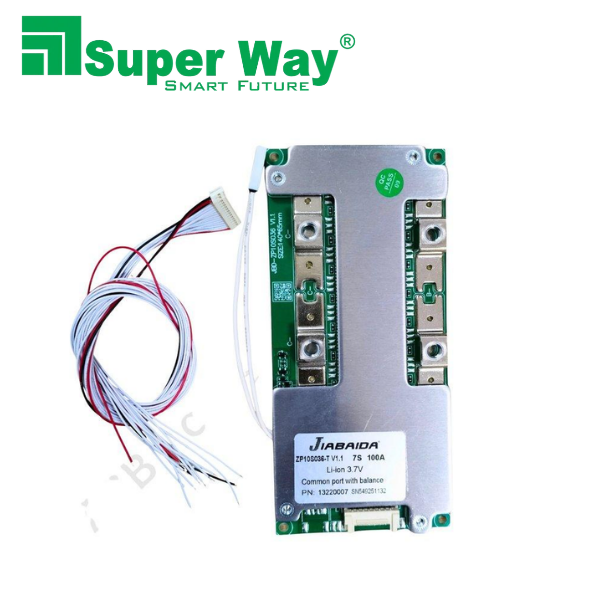
BMS NMC 7S 100A ZP10S036
Original price was: ₹2,500.00.₹900.00Current price is: ₹900.00.
WHOLESALE PRICE
- Product Type: Battery Management System (BMS)
- Battery Chemistry: NMC lithium-ion battery chemistry
- Cell Configuration: 7S, designed for compatible seven-series-cell battery packs
- Current Rating: 100A, as indicated in the product name
- Model Number: ZP10S036
- Application: Suitable for compatible NMC battery pack projects, subject to verification of the exact technical specifications.
Did you like this product? Add to favorites now and follow the product.
Description
The BMS NMC 7S 100A ZP10S036 is a Battery Management System intended for compatible seven-series-cell lithium-ion battery packs using NMC chemistry. A Battery Management System is an important component in rechargeable battery assemblies because it monitors or manages selected electrical operating conditions according to its design. This product is identified by its NMC battery chemistry, 7S configuration, stated 100A current rating, and ZP10S036 model number. These details help buyers identify the general configuration required for a battery project or replacement application. SUPERWAY presents this product for customers looking for battery management components for compatible lithium-ion battery systems.
NMC refers to Nickel Manganese Cobalt, a lithium-ion battery chemistry used in a variety of rechargeable battery applications. The 7S designation generally means that seven cell groups are connected in series. A series configuration affects the total battery pack voltage, while the usable voltage range depends on the specifications of the individual cells. The correct charging voltage, discharge limits, and operating range must therefore be determined from the battery-cell manufacturer’s documentation. Before choosing a BMS, buyers should confirm that their battery pack uses NMC chemistry and a seven-series configuration compatible with this model.
The 100A designation is a key identification detail for this product. However, the actual continuous current capability, permitted peak current, and operating limits must be confirmed using the technical datasheet for the exact model. Current performance can depend on the circuit design, cooling conditions, installation method, wiring, connectors, and surrounding temperature. The cells and every component connected to the BMS must also support the intended current. A product name alone does not establish the conditions under which a stated current rating can be maintained, so the manufacturer’s specifications should be checked before the unit is used in a battery assembly.
A BMS may provide functions such as cell-voltage monitoring, charging and discharging control, and protection against certain electrical conditions. Depending on its design, it may also support overcurrent protection, short-circuit protection, temperature monitoring, overvoltage protection, or undervoltage protection. These features should not be assumed to be present in every model. Buyers should obtain the documentation for the ZP10S036 and verify the actual protection functions, operating thresholds, and recovery behaviour before relying on the device in a battery system.
Cell balancing is another possible function of a multi-series battery management system. Battery cells may develop differences in voltage during charging and discharging, and a balancing circuit can help manage these differences. The exact balancing method, supported balancing current, and operating conditions vary between BMS designs. Confirm whether this model includes balancing and review the corresponding specifications before purchase. The presence or absence of balancing should be established from the official technical information rather than inferred from the seven-series configuration.
Compatibility involves more than matching the series count and current rating. Buyers should check the required battery voltage range, current limits, terminal layout, connector type, wiring arrangement, physical dimensions, and any temperature-sensor or communication requirements. The model number ZP10S036 can help identify the intended unit when requesting a datasheet or wiring diagram. If this product is being considered as a replacement for an existing BMS, compare the electrical specifications and connection sequence of both units. Components with similar names may still have different wiring layouts or operating characteristics.
Safe installation is essential when assembling lithium-ion battery packs. Incorrect wiring, reversed polarity, unsuitable connections, or a mismatch between the BMS and battery configuration can damage components and create safety hazards. The wiring order must follow the manufacturer’s instructions for the exact model. Before connecting a charger or load, the battery pack should be checked for correct polarity, appropriate cell-group voltages, secure connections, and suitable insulation. Installation should be carried out by a person with the relevant technical knowledge and suitable equipment, especially where high-current circuits are involved.
The charger must be compatible with the battery chemistry and the specific series configuration. Its charging voltage and current should remain within the limits specified for the battery cells and the complete battery assembly. The BMS should not be treated as a substitute for a suitable charger, properly matched cells, correctly sized wiring, or appropriate electrical protection. Likewise, the load must remain within the documented operating limits of the battery cells, BMS, connectors, and conductors. The finished assembly should be inspected before being put into regular service.
A BMS with a suitable seven-series configuration may be considered for compatible battery-powered equipment, portable power projects, and other rechargeable battery applications. Whether this particular model is suitable depends on the actual electrical requirements of the project and the verified functions of the device. Buyers should also consider the expected load, operating environment, available cooling, enclosure arrangement, and maintenance requirements. These factors help determine whether the selected component is appropriate for the intended battery system.
When sourcing the BMS NMC 7S 100A ZP10S036, use the product’s identifying details to confirm the exact version with the supplier. Request the technical datasheet, connection diagram, continuous and peak current limits, supported voltage range, balancing information, and details of the available protection functions. Confirm any required communication interface or temperature sensor before ordering. This verification is particularly important when replacing an existing BMS or integrating the unit into a custom battery pack.
The BMS NMC 7S 100A ZP10S036 is intended for buyers seeking a battery management component for a compatible seven-series NMC lithium-ion battery configuration. SUPERWAY provides this product listing to help customers identify the relevant chemistry, series count, stated current rating, and model number when sourcing battery components. Verify the technical documentation and compatibility with the cells, charger, load, wiring, and installation requirements before purchasing or installing the unit.
Recently Viewed Products
TDT BMS LFP 11S 50A Two Port
Original price was: ₹1,600.00.₹700.00Current price is: ₹700.00.
JBD LFP BMS 23S 40A ZP24SA01
Original price was: ₹2,000.00.₹900.00Current price is: ₹900.00.
BMS NMC 7S 100A ZP10S036
Original price was: ₹2,500.00.₹900.00Current price is: ₹900.00.
We are committed to quality, innovation, and powering your needs with trusted energy products.
Copyright 2026 © lithiumbatterys.com

Reviews
There are no reviews yet.