

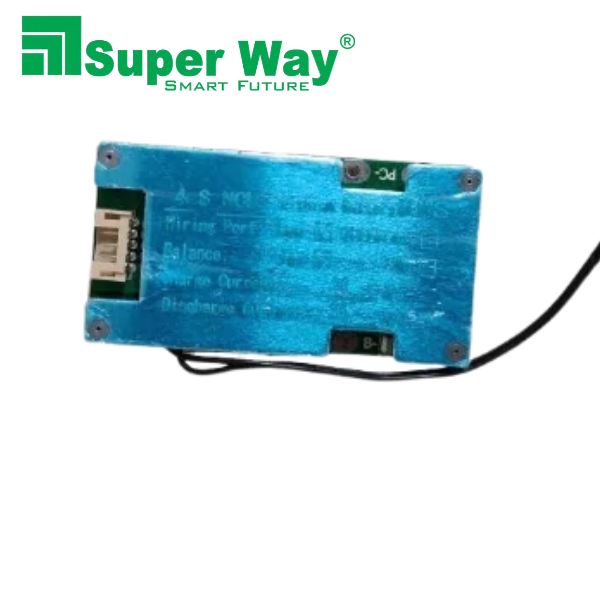
BMS NMC 4S 20A with Balancing
Original price was: ₹500.00.₹100.00Current price is: ₹100.00.
WHOLESALE PRICE
- Designed for compatible 4S NMC lithium-ion battery packs.
- Specified current rating of 20A.
- Intended for four cells connected in series.
- Includes a balancing function as indicated in the product name.
- Suitable for compatible rechargeable battery pack applications.
- Verify voltage limits, current requirements, wiring connections, and protection specifications before installation.
Did you like this product? Add to favorites now and follow the product.
Description
The BMS NMC 4S 20A with Balancing is a battery management system intended for compatible four-cell series NMC lithium-ion battery applications. It has a specified current rating of 20A and includes a balancing function as indicated in the product name. This circuit may be considered when selecting a battery management component for a rechargeable battery pack that requires a four-cell series configuration. Before purchasing or installing the product, verify the technical specifications, battery compatibility, connection arrangement, and physical dimensions to ensure that the circuit is suitable for the intended application.
A battery management system, commonly known as a BMS, is an electronic circuit designed to manage specified operating conditions in a rechargeable battery pack. Depending on its design, a BMS may monitor battery voltage, control charging or discharging within defined limits, and provide protection against particular electrical conditions. The functions provided vary between models. The product name alone does not confirm whether this specific circuit supports overcharge protection, over-discharge protection, overcurrent protection, short-circuit protection, temperature monitoring, or other features. Buyers should consult the technical documentation for the exact model to determine which functions are available.
The 4S designation indicates that the battery pack contains four cells connected in series. In a series arrangement, the individual cell voltages add together, while the ampere-hour capacity generally remains comparable to that of one cell when the cells are appropriately matched. A four-cell series pack therefore has different voltage requirements from a single-cell, two-cell, or three-cell pack. Selecting a BMS designed for the correct series configuration is essential. A circuit intended for a different number of series-connected cells should not be substituted without confirming compatibility with the complete battery assembly.
NMC stands for nickel manganese cobalt oxide, a type of lithium-ion battery chemistry. NMC cells have specific charging voltage limits, discharge requirements, and operating temperature ranges. The selected BMS must be suitable for the chemistry and configuration of the battery pack. The charger must also be compatible with the complete four-cell series arrangement. Users should consult the cell manufacturer’s documentation to determine the correct charging voltage, permitted charging current, discharge limits, and other operating requirements. A connector that physically fits does not establish that a charger is electrically suitable.
The specified 20A current rating is an important consideration when evaluating this component. The expected current drawn by the connected equipment should be determined before choosing the circuit. Current demand can vary according to the load, wiring, connectors, operating temperature, and overall system design. The exact meaning and limitations of the 20A rating should be verified in the product documentation, including any restrictions on continuous operation and environmental conditions. Users should not assume that the circuit can safely support a current above its specified rating or that the same limit applies under every operating condition.
The balancing function indicated in the product name is relevant to series-connected battery packs. Individual cells can develop differences in voltage and state of charge during charging and use. A balancing circuit is designed to manage certain differences between cells according to its particular operating method. Balancing performance varies between circuit designs, so the balancing method, current, activation conditions, and supported voltage range should be checked in the technical documentation. Balancing does not replace properly matched battery cells, a compatible charger, or other necessary battery protection measures.
This BMS may be considered for compatible rechargeable battery assemblies, portable equipment, and electronics projects that use four NMC cells connected in series. Actual suitability depends on the battery specifications, connected load, required current, charging system, wiring arrangement, and protection functions provided by the circuit. Before ordering, determine the operating requirements of the intended application and compare them with the documented capabilities of the board. If the project requires a specific balancing performance, temperature-monitoring function, or protection threshold, confirm that the model supports that requirement before purchase.
Correct wiring is essential when installing a battery management circuit. The battery terminals, individual cell connection points, charging terminals, and load connections must be identified using the circuit markings and wiring diagram for the exact model. Do not rely only on wire colours or assume that terminal arrangements are identical across different BMS products. Incorrect polarity, misplaced cell connections, and accidental short circuits can damage the battery and circuit and may create a serious safety hazard. If the connection diagram is unavailable or unclear, have a qualified technician verify the wiring before connecting the battery pack.
Physical compatibility should also be checked before installation. Confirm the circuit board’s dimensions, terminal spacing, mounting requirements, and clearance from surrounding components. The circuit should be protected from moisture, conductive debris, mechanical stress, and accidental contact with conductive materials. Wiring and connectors must be appropriate for the intended application. The complete battery assembly should be housed in a suitable enclosure that protects the cells and circuit from foreseeable damage and supports operation within their specified limits.
The charging system must be designed for the NMC chemistry and four-cell series configuration. Charging voltage and current settings must comply with the battery manufacturer’s instructions. A charger intended for a different chemistry or cell count may be unsuitable even if its connector fits. The BMS should not be considered a replacement for a correctly specified charger or as a guarantee against every possible battery fault. The cells, BMS, charger, wiring, connectors, load, and enclosure must all be considered when designing the complete battery system.
During handling and inspection, keep the circuit dry and protect its terminals from conductive objects. Do not use battery cells that are damaged, swollen, leaking, or abnormally hot. If the battery or circuit behaves unexpectedly during testing, stop using the assembly and have it inspected by a qualified person. Lithium-ion battery packs require careful handling, and installation should be performed by someone familiar with the relevant electrical and battery-safety procedures.
When comparing battery management components, buyers should consider the number of series-connected cells, supported chemistry, current rating, balancing function, documented protection features, wiring arrangement, physical dimensions, and installation requirements. The BMS NMC 4S 20A with Balancing should be selected only after its verified specifications have been compared with the requirements of the intended battery pack.
SUPERWAY presents this BMS NMC 4S 20A with Balancing as an option for customers researching battery management components for compatible four-cell NMC lithium-ion applications. Its stated configuration, current rating, and balancing function provide starting points for evaluating its suitability. Confirm the full technical specifications before purchase, follow the battery cell manufacturer’s instructions, and use a compatible charging system. If the electrical connections or operating requirements are uncertain, consult a qualified technician to help ensure that the complete battery assembly is appropriate for its intended application.

BMS NMC 4S 20A with Balancing
Original price was: ₹500.00.₹100.00Current price is: ₹100.00.
We are committed to quality, innovation, and powering your needs with trusted energy products.
Copyright 2026 © lithiumbatterys.com

Reviews
There are no reviews yet.